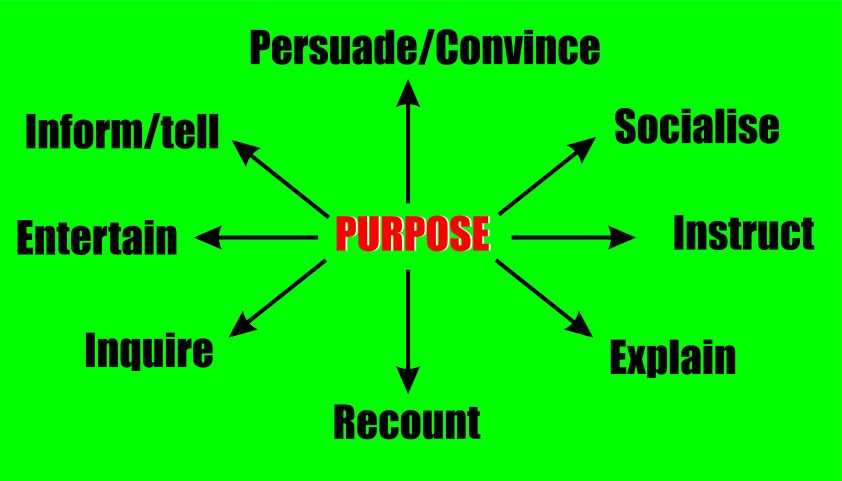
Definition of Register and Varieties of Spoken and the written language

Register
is a subset of language as defined by purpose and setting

Varieties
A Variety also called “Lect” is a
specific form of language or language cluster.
this may include languages, dialects, registers,
styles or other forms of language, as well as “Standard Variety”

  • Filipino-Standard Variety of the Philippines
  • Varieties of the Philippines

a. cebuano
b. waray-waray
c. Ilocano
d. kapampangan
e. Hiligaynon

  • Types of Registers
    a. Frozen – is a language that never changes. ( Ex. Panatang Makabayan ).
    b. Formal – Standard English. (Ex. Speeches or School Lessons)
    c. Consultative – Less Formal Standard English (Ex. Newscasting )
    d. Casual – Language between Friends (Ex. Vernacular Speech)
    Intimate – Language between lovers or other close family pr friends
    Spoken Language – is a language produced with vocal tract. it tends
    to convey subjective information.
    Written Language – is a representation of spoken or gestural by means of a writing system
    – it must be taught to children.

Image result for Definition of Register and varieties of Spoken and the written language clip art

Evaluating Messages and Images

“EVALUATING MESSAGES”
*The importance of evaluating the effectiveness of our messages is by developing and using strategic questions to identify strengths and weaknesses

“FOUR MAIN QUALITIES FOR AN EFFECTIVE MESSAGE”
1. Simplicity
2. Specificity
3. Structure
4. Stickiness

” STRATEGIES FOR EVALUATING A MESSAGE “
– In order to evaluate whether a message is effective, we can ask ourselves a series of questions which reflect a messages simplicity, specificity, structure and stickiness.

1. SIMPLICITY
* In order to ensure that our messages have simplicity, we should
ask ourselves two questions:
– is my purpose evident?
– Is my core message clear?

2. SPECIFICITY
*Refers to our choices of language and its usage on order to ensure
language is specific we may ask ourselves:
– Is my language specific?
– is my language concrete, rather than abstract?
– am i suing words which have additional meanings and could perhaps be misconstrued?

3. STRUCTURE
*Ideas should be organized and easy to follow.
– Does my messages have a STRUCTURE?
– is there a more effective way to arrange my ideas?

4. STICKINESS

“EVALUATING IMAGES”
* It is important to critically evaluate images you use for research, study and presentation images should be evaluated like any other source, such as journal articles or books, to determine their quality, reliability and appropriateness. Visual analysis is an important step in evaluating an image and understanding its meaning and also. there are three steps of evaluating an image and these are:

1. Identifying Source
2. Interpret contextual information
3. Understand implications

“CONTENT ANALYSIS”

  • What do you see?
  • What is the image all about?
  • Are their people in the image?
  • What are they doing?
  • How are they presented?
  • Can the image be looked at different ways?
  • How effective is the image as a visual message?


“VISUAL ANALYSIS”

  • How is the image composed?
  • Whats in the Background and what is in the foreground?
  • What are the most important visual?

“IMAGE SOURCE”

  • Where did you find the image?
  • What information does the source provide about the origins of the image?
  • Is the source reliable and trustworthy?
  • Was the image found in an image database or was it being use in another context to convey meaning?

“TECHNICAL QUALITY”

  • Is the image large enough to suit your purposes?
  • Are the color, light and balance, true?
  • Is the image a quality digital image without pixelation or distortion?
  • Is the image in a file format you can use ?

“CONTEXTUAL INFO”

  • What information accompanies the image?
  • Does the text change how you see the image?How?
  • Is the textual information intended to be factual an inform or is
    to intended to influence what and how you see?
  • What kind of context does the information provide?
  • Does it anser the questions where,how why and

Image result for Evaluating Messages and Images clip art

Communication Aids and Strategies using Tools of Technology


SIGN LANGUAGE

Sign language, any means of communication through bodily movements, especially of the hands and arms, used when spoken communication is impossible or not desirable. The practice is probably older than speech. Sign language may be as coarsely expressed as mere grimaces, shrugs, or pointings or it may employ a delicately nuanced combination of coded manual signals reinforced by facial expression and perhaps augmented by words spelled out in a manual alphabet. Wherever vocal communication is impossible, as between speakers of mutually unintelligible languages or when one or more would-be communicators is deaf, sign language can be used to bridge the gap.

Language Barrier

Chinese and Japanese, whose languages use the same body of characters but pronounce them entirely differently, can communicate by means of a sign language in which one watches while the other traces mutually understood characters in his or her palm. Evidence of long use of sign language to communicate around mutually unintelligible languages exists for Africa, Australia, and North America. The most generally known model is that of the Plains Indians of 19th-century North America. Although their languages were dissimilar, the mode of life and environment of all groups had many shared elements, and, consequently, finding common symbols was easy. Thus, a cupped hand leaping and bobbing away from the “speaker” was familiar to all as the rump of a bounding deer; a circle drawn against the sky meant the moon—or something as pale as the moon. Two fingers astride the other index finger represented a person on horseback; two fingers spread and darting from the mouth like the forked tongue of a snake meant lies or treachery; and the gesture of brushing long hair down over the neck and shoulder signified a woman. This sign language became so familiar that long and complex narratives—in monologue or dialogue—could be signed and understood within large groups of Indians otherwise unable to communicate.

Inability To Speak

The Indian sign language was codified by use into an explicit vocabulary of gestures representing or depicting objects, actions, and ideas, but it made no attempt to “spell out” or otherwise represent words that could not be conveyed by gestures. Several forms of sign language were developed to enable signers to spell out words and sounds, however. Most of these are as complex and flexible as spoken languages.

It was long thought in many cultures that the deaf were ineducable, and the few teachers willing to try were available only to the wealthy. In the mid-18th century, however, the first educator of poor deaf children, Charles-Michel, abbé de l’Epée, developed a system for spelling out French words with a manual alphabet and expressing whole concepts with simple signs. From l’Epée’s system developed French Sign Language (FSL), still in use in France today and the precursor of American Sign Language (ASL) and many other national sign languages.
FSL was brought to the United States in 1816 by Thomas Gallaudet, founder of the American School for the Deaf in Hartford, Connecticut. The new sign language was combined with the various systems already in use in the United States to form ASL, which today is used by more than 500,000 deaf people in the United States and Canada; it is the fourth most common language in the United States. National sign languages such as ASL have more in common with one another than with the spoken languages of their country of origin, since their signs represent concepts and not English or French or Japanese words. One system, Cued Speech, first developed by the American physicist R. Orin Cornett in 1966, does, however, successfully employ hand signs representing only sounds (not concepts), used in conjunction with lipreading. It has been adapted to more than 40 languages.

Related image


STRATEGIES

WEB-BASED MEANING?

A web-based application is any program that is accessed over a network connection using HTTP, rather than existing within a device’s memory. Web-based applications often run inside a web browser. However, web-based applications also may be client-based, where a small part of the program is downloaded to a user’s desktop, but processing is done over the internet on an external server.

Web-based applications are also known as web apps.

Techopedia explains Web-Based Application

There is a lot of confusion created by the use of terms like web-based, internet-based and cloud-based when referring to applications. Web-based applications actually encompass all the applications that communicate with the user via HTTP. This includes light applications like Flash games, online calculators, calendars and so on, as well as more intensive applications such as web-based word processors and spreadsheet applications.

HOWTO MAKE A BLOG?

How to Start a WordPress Blog


Here’s the quick summary of the set up stages that we’re going to cover in the rest of the article below:

  1. Purchase your blog hosting — This is where you install WordPress and host your future blog’s files, articles and images.
  2. Install WordPress from your new cPanel — Install WordPress with just a few clicks from inside your host’s control panel.
  3. Choose a free theme for your blog — Pick a theme that suits the colors, branding and goals for your blog and install it from your new WordPress blog’s dashboard.
  4. Publish your first post — Now start writing amazing blog posts that help people, attract traffic, get email subscribers, and more.

Now let’s get into the step-by-step, detailed tutorial on how to start a WordPress blog that over 8,000 people have now used to start blogging properly! As I mentioned in my latest blog hosting review it literally only takes a few clicks to get your own blog.

Step 1 — Purchase your WordPress blog and domain name hosting package

The first thing we need to do is purchase some domain name and blog hosting. This is where all of your blog’s files are stored, and where we will eventually install WordPress as your blogging platform.

(The following images are screenshots I’ve taken from Bluehost so you know what to do. Open up Bluehost in a new window and follow along.)

Once you’ve arrived at Bluehost, click the green Get Started Now button that you can see in this image and that will begin the process.

start a wordpress blog step one

On the next page enter in the domain name that you’d like to use.

You can add unlimited websites and blogs to your Bluehost account so don’t worry too much if you’re not totally sold on your current domain name idea because you can always add more to the same account later using the Addon Domains feature.
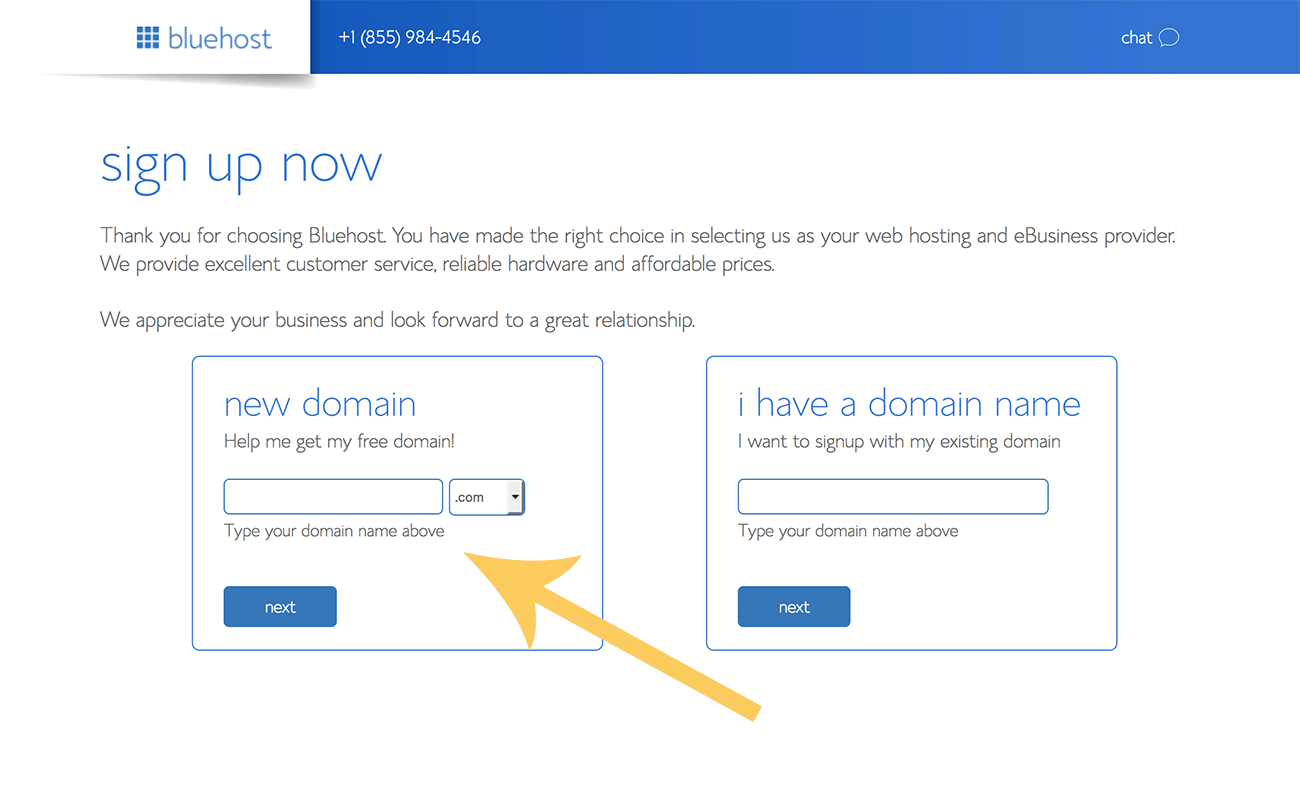
start a wordpress blog step two imageThe next step is easy – just fill out all your contact details and payment information (billed annually). Make sure you use your real details so you can verify your account.

As you can see below, that same screen has some optional extras. It is up to you whether or not you purchase these but I would generally recommend you buy the Whois privacy as this keeps your email, address and other private details hidden on the web.
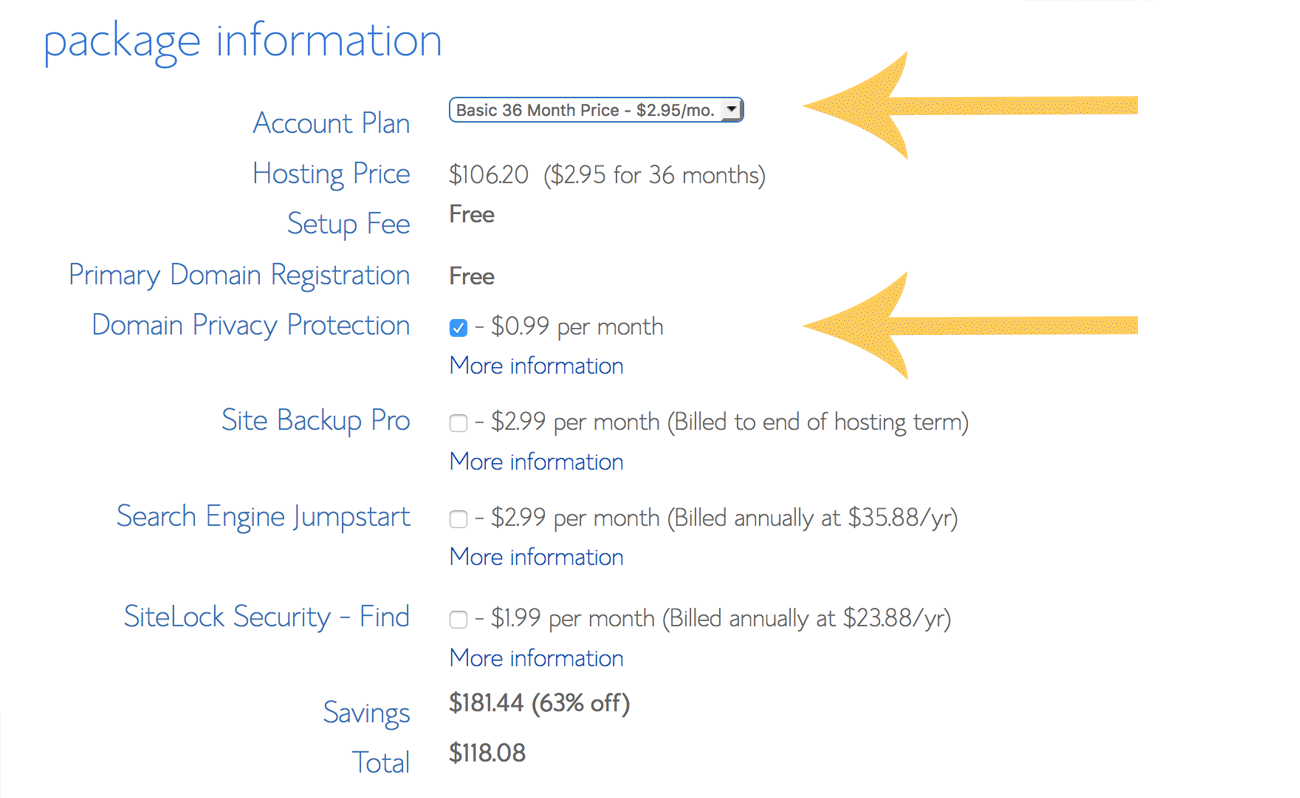
start a wordpress blog step threeAt this point you should have completed the first step and you’ll have your very own professional blog hosting area. Congratulations!

Step 2 — Install WordPress for free from your new cPanel within Bluehost

Now that you have purchased your domain name and hosting package you will get given access to something called a cPanel (short for Control Panel).

This is the “engine” of your hosting and has dozens of different icons that link to all the different services and features that are available inside your hosting account such as email, scripts, accounts, and more.

At first it will seem a little overwhelming but don’t worry, you can ignore 95% of them. But this is the page where we need to find the little WordPress icon so we can make our first WordPress blog.

IMPORTANT: I’m going to show you how to do a WordPress install by yourself but you can always ask Bluehost to do it for you. This is a message you’ll see when you first get cPanel access.
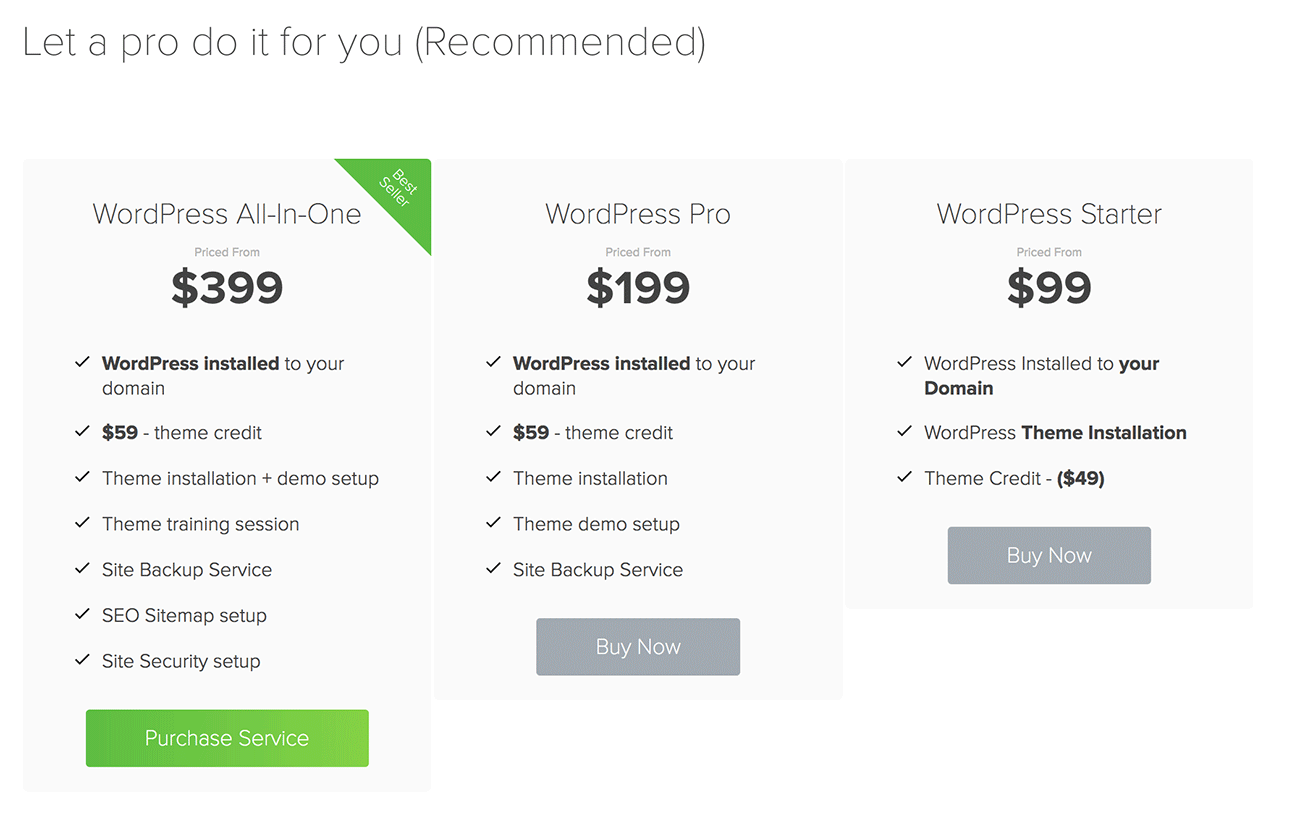
do it for meWe’re going to ignore that message because installing it ourselves is easy!

Scroll down until you find the icon called Install WordPress. This is the amazing new software that lets you install WordPress on your host in just a few clicks.
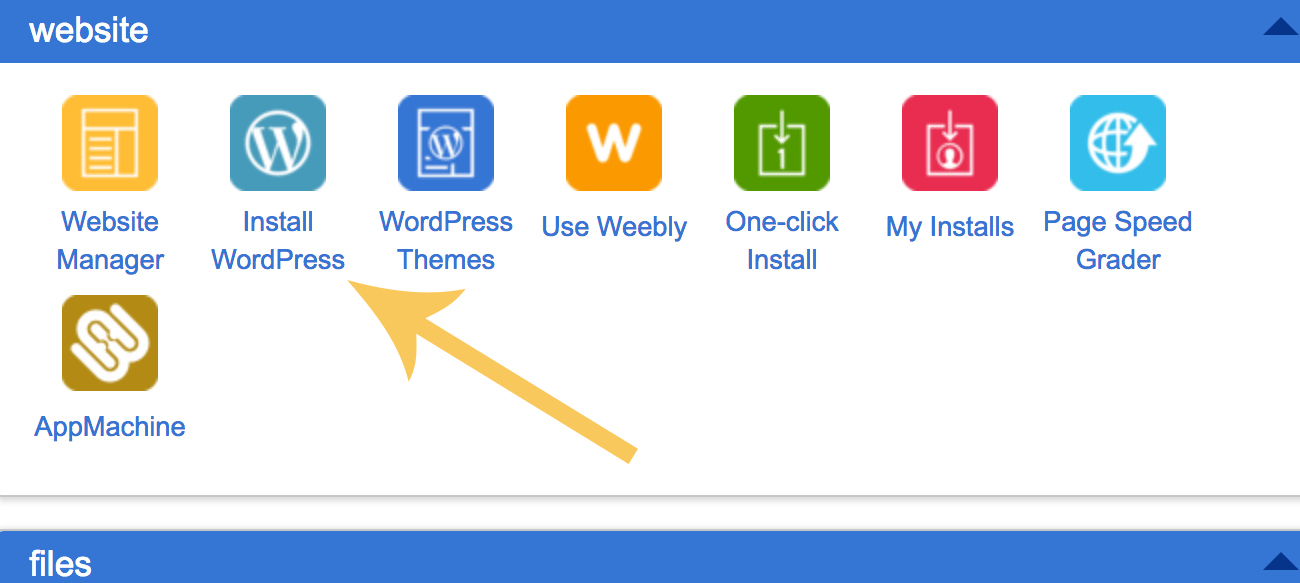
Install WordPressNow, the next screen has a few options but is actually really simple.
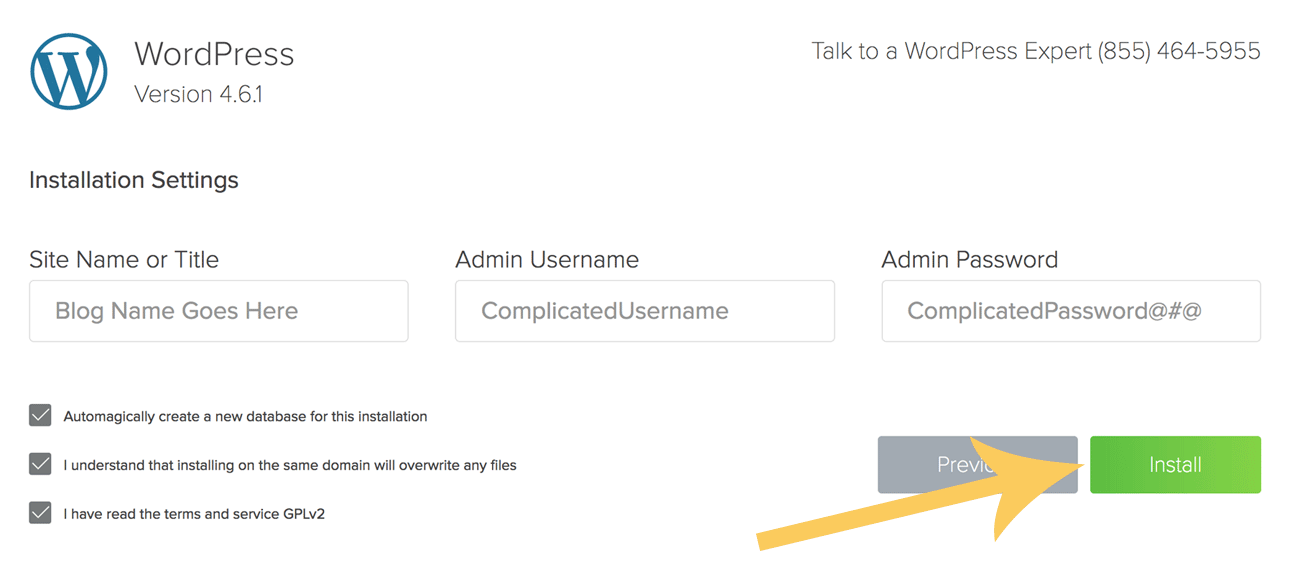
install wordpress blog stepHere you want to fill out all the options like the name of your blog while also making sure you use a complex username (not admin) and password. This is literally all you have to do to get started.

And you’re done!

Once it has finished crunching the installation it will give you a confirmation screening showing you your unique WordPress login URL that will look like this:

http://yourdomain.com/wp-admin

Copy this and bookmark it and make sure you write down your username and password on a piece of paper. Never write this information down on your computer.

This URL is where your WordPress Dashboard is located. This is the “back end” of of your blog and it’s where you publish posts, change themes, edit fonts, upload images and generally run your blog. From this point onward you don’t need to log back in to the cPanel to blog.

That’s it!

Step 3 — Change your WordPress theme

The final (and most rewarding) step in the process is where you install a beautiful new WordPress theme and start writing your first posts!

To change your theme simply login to your WordPress dashboard using the URL we got above and go APPEARANCE > THEMES > ADD NEW and then use the search box to find a theme that suits your needs. There are literally thousands to choose from.
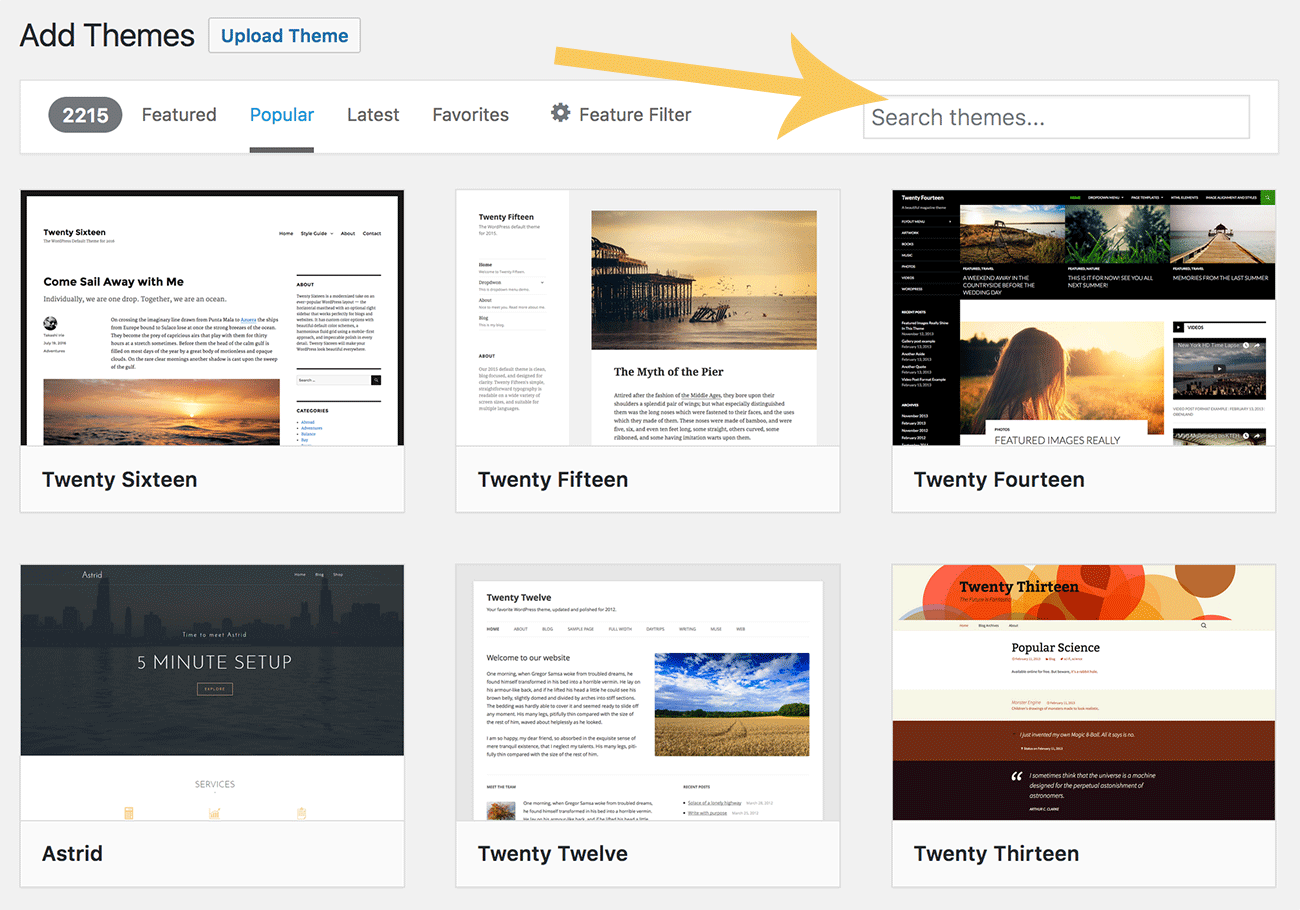
install themeOnce you have found a theme that you like you can it’s a good idea to check that it has good ratings from other bloggers and that it has been updated regularly.

You can preview it in this window pane or you can just install it right there!

Now you are ready to start blogging on your new WordPress blog! That whole process from sign up to installing a theme can literally only take five minutes to do. Just follow this guide and if you run in to any problems you can ask one of Bluehost’s amazing live support crew for help. They are there 24 hours a day.

Step 4 — Start building a successful blog

Once you have started a WordPress blog it’s a good idea to have a look at how to create amazing content for your blog.

After all, there is no point going to all the trouble of starting a blog if you don’t put something great on it!
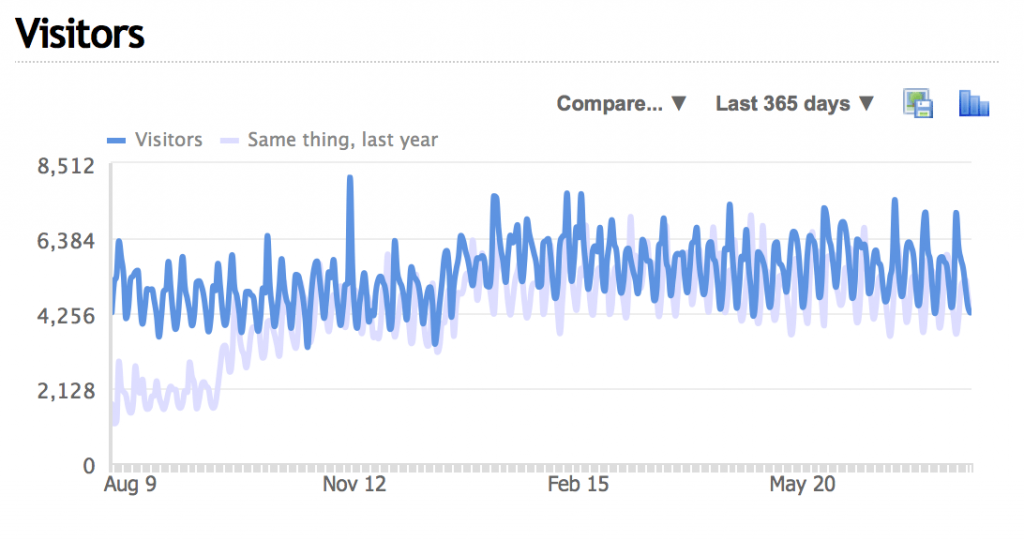
traffic

I really recommend taking an approach that involves a deliberate blogging strategy that helps you to get more traffic from Google, lands you consistent email subscribers, and builds you a profitable blog over time.

Here’s some things you might want to do:

  • Find a point of difference
    It’s important to find a way to make your blog stand out from the rest. Take a look at your competition and figure out a way you can be different. This is vital.
  • Come up with a plan
    Next you want to sit down and come up with a basic content plan and what goals that plan has. When you have some set goals it shapes all of your future posts.
  • Start a mailing list
    A mailing list is an essential part of any blog. It allows you to promote new posts, product or affiliates and can be a huge protection from changing SEO rankings.
  • Write long-form content
    Longer posts get better results in terms of Google rankings and social shares. Try to make your posts between 1,500 and 5,000 words if you want to really make an impact.
  • Build your networks
    Blogging financial success usually comes from your networks. Make friends with other bloggers in your niche, share their stuff and link to them. These connections will help over time.


Types of Speech and Public Speaking

Types of Public Speech

1. INFORMATIVE SPEECHES
– involve a knowledgeable speaker transferring some of
their knowledge to their audience.

KEY TERMS
– A Speaker should be very knowledgeable about the topic
– The topic can be the range from a detailed method to an abstract concept
– Narrower topics makes comprehensible speeches.
– Practice any speech multiple times

Four distinct categories of topic:

  • Things,People or places
  • Methods
  • Events
  • ideas

2. PERSUASIVE SPEECHES
– A Speaker attempts to persuade the audience to adopt
his/her position in relation to a topic

KEY POINTS:
– INTENDS to persuade the audience to adopt the position of the speaker
Know your Audience
An Appeal to used to show the characters of the speaker and make him/her more credible
– The core of a persuasive speeches is pair appealing to and audience feelings.

INFORMATIVE VS. PERSUASIVE SPEECHES
Many speeches will contain elements of both informative and Persuasive speeches.

Key points
* an informative speech aims to inform the audience about a specific topic
* a persuasive speech aims to persuade the audience to perform a certain action or convince the audience
* many speeches will combine features of the two speeches
* know your audience
* considering the purpose of the speech

3. Speeches for Special Occasions
– Some special occasions required speeches that are different that
speeches owned at informing or persuading audiences.

KEY POINTS
– Tends to be shorter speeches, commonly less than ten minutes
– commonly addressed to a particular audience
– Defending on the context it could be Funny or Sad.

1. INFORMATIVE COMMUNICATION
– tends to share knowledge and attempt to present an objective that is truthful and unbiased
2. PERSUASIVE COMMUNICATION
– MAY BE DEFINED AS THE PROCESS THROUGH WHICH PEOPLE ATTEMPT TO INFLUENCE THE BELIEFS OR ACTIONS OF OTHER
3. ARGUMENTATIVE COMMUNICATION
– It is a undefying Argumentative individuals advocate positions on instrumental issues and verbally attack
other people’s contradicted perspectives.

Image result for Communication Aids and Strategies using Tools of Technology clipart


1. Speaking to inform (Informative)
– when the speaker is presenting interesting facts or lessons to the audience or explain how to go about doing something.

2. Speaking to Persuade, Motivate pr Take Action
– This is when speaker will try influencing the audience in some
way this speaker might be trying to change your mind absent
something to persuade you to change your opinion to motivate to change a behavior or to take action
3. Speaking to Entertain
– this type of speaking is often found at events like banquets, weddings or
dinners this speaker is usually sharing a funny story or their anectodal information.

purpose


Business Communication

Business Communication

Sharing of ideas and attitudes on official o organization Level.

Types of Business Letter

letters of recognition
Employees plan to leave this job
Memorandum letter
handwritten note
Follow-up Letters
Sales department thanking customer for order
Letters of recommendation
Employees ask join applicants for letters of recommendation before they hire them.
Acknowledgement Letter
Sample Receipts
Cover Letters/Application Letter
describe what or enclosed why it is sent and what the receipt should do.

6 Reasons why effective communication should be focus in your business

1. Builds and maintains relationships
2. Facilities Innovation
3. Builds an Effective team
4. Managing Employees
5. Contributes to growth of the company
6. Ensures Transparency

Types of Business Reports
1. Analytical
2. Informational
3. Research

1. Order Letter
2. Adjustment Letter
3. Order Letter
4. Complaint Letter

Effective Business Communication
* Face to Face
* E-mail
* Telephone
* Listening


Image result for business communication clipart


Communication For Academic Purposes

Communication For Academic Purposes

Scientific Study of Communication
1. Information Theory
2. Biosemiotics
3. Communication Studies

3 Types of Communication
1. Verbal
2. Non-verbal
3.Written

Daily Transaction
1. Intrapersonal Content Relation Communication
2. Family Communication
3. Business Communication

Communication is one of the relevant tools in Political strategies
including, Persuasion & propaganda (mass media,multimedia)

Form of Communication
1. Intrapersonal
2. Interpersonal
3. Group
4. Public
5. Mass

3 PARTS OF Communication
Sender
Channel
Receiver

Information Source

Transmitter
Channel
Noise
Receiver
Destination

Types of Business Proposal

1. Solicited Business Prop.
2. Formally Solicited Bus. Prop.
* RFP (REQUEST FOR PROPOSAL)
* RFQ ( REQUEST FOR QUOTATION)
* IFD ( INVITATION FOR BID)

TOP 5 ITEMS TO INCLUDE IN A BUSINESS PROPOSAL

1. A HACK
2. A PROBLEM
3, A PLAN
4. YOUR QUALIFICATIONS
5. COSTS


Image result for communication for academic purposes clipart

Research

Research  is a process of systematic inquiry that entails collection of data; documentation of critical information: and analysis and interpretation of that data/information, in accordance with suitable methodologies set by specific professional fields and academic disciplines. Research is conducted to evaluate the validity of a hypothesis or an interpretive framework; to assemble a body of Substantive knowledge and findings for sharing them in appropriate manners; and to generate questions for further inquiries.

A Topic Proposal basically a short “sales pitch” to submit your selected subject matter to your instructor and persuade him/her to accept it as applicable to the assignment, and worthy of both time and effort. Complete a 100 word minimum Topic Proposal for your research essay. This must be typed and formatted using MLA style using complete sentences and paragraph format, explain as specifically as possible what your topic will be. Argue for the relevance or significance of your topic. How does it meet the definition of social problem? Who do, the problem involve? What causes or effects can you currently predict prior to further research? What is your general purpose or point? Who is your intended audience and why? Con you formulate a thesis statement yet?

There are different data gathering procedures that you can use for a term paper. It will depend on your convenience and ‘he ease in gathering toe required details that you can use for the research results. In any case, we will discuss some of the major types of data gathering procedures.

Data Mining This procedure is simple. you can easily find many resource materials where data and numerical figures are already tallied and presented. Usually, your can find data among research institutions and academic centers. Data mining is simply using an already published set of data.

Interviewing is another example of a date gathering procedure. One benefit that you can get from this process is that you can actually gather raw and reliable data direct from your subjects. Although it is time consuming, you can stiIl have very credible result from this data gathering procedure.

Surveyingactually involves gathering responses from subjects through a written medium. You will be distributing paper questionnaires for vour subjects to answer. You will then tally the results and use the data for your research.

A literature review is a critical analysis of published sources, or literature, on a particular topic. It is an assessment of the literature and provides a summary, classification, comparison and evaluation. At postgraduate level literature reviews can be incorporated into an article, a research report or thesis. At undergraduate level literature reviews con be a separate stand-alone assessment.

The literature review is generally in the format of a standard essay made up of three components: on introduction, a body and a conclusion. It is not a list like an annotated bibliography in which a summary of each source is listed one by one

Data Analysis is the process of systematically applying statistical and/or logical techniques to describe and illustrate, condense and recap, and evaluate data While data analysis in qualitative research con include statistical procedures, many tomes analysis becomes an ongoing iterative prowess where data is continuously collected and analyzed almost simultaneously. Indeed, researchers generally analyze for patterns reservations through the entire data collection phase. The farm of the analysis is determined by the specific qualitative approach token (field study, ethnography content analysis, oral history, biography, unobtrusive ‘ and the form of the data (field notes. documents, audiotape, and videotape).


Image result for research clipart


Learning Experienced

Communication activities are done in real life. In this particular subject, I would be practice some strategies of effective communication and the appropriate language. Based on my learning experienced on this subject, I exposed my ability and sharpen my skills through conversing intelligently on a subject of import and reporting on a group. I’ve learned also on how to listen carefully, to comprehend some thoughts and ideas, and to respond the conversations like we explain extended texts in our own words using examples to bolster explanation, to do some research on an assigned topic and to make a web based presentation in which is a blog. During my second year college, first semester in Xavier University. I was be able to study English 17 subject in which the descriptive title was “Effective Speech Communication” and that was year 2006. I’ve learned a lot of things from that subject like on how to pronounce the words or the letters properly, to have an oral communication almost everyday and to have an impromptu speech in front of my block mates. English 17 was the most difficult for me of all those English subjects that I have been taken. I was so nervous every time our teacher would tells us that we will have impromptu because it was not so easy to answer those questions in front of a lot of people. I couldn’t think clearly and to answer those questions properly because I was so very conscious on my grammar at that time knowing that most of my block mates are came from the different standard schools. I am very glad that I was be able to take this subject in this course because it refreshing my mind and I already apply those techniques, learning experienced and strategies that I have learned on my English 17 to my purposive communication subject today.